Living on More Than Bread
Feeding the soul. Training the flesh.

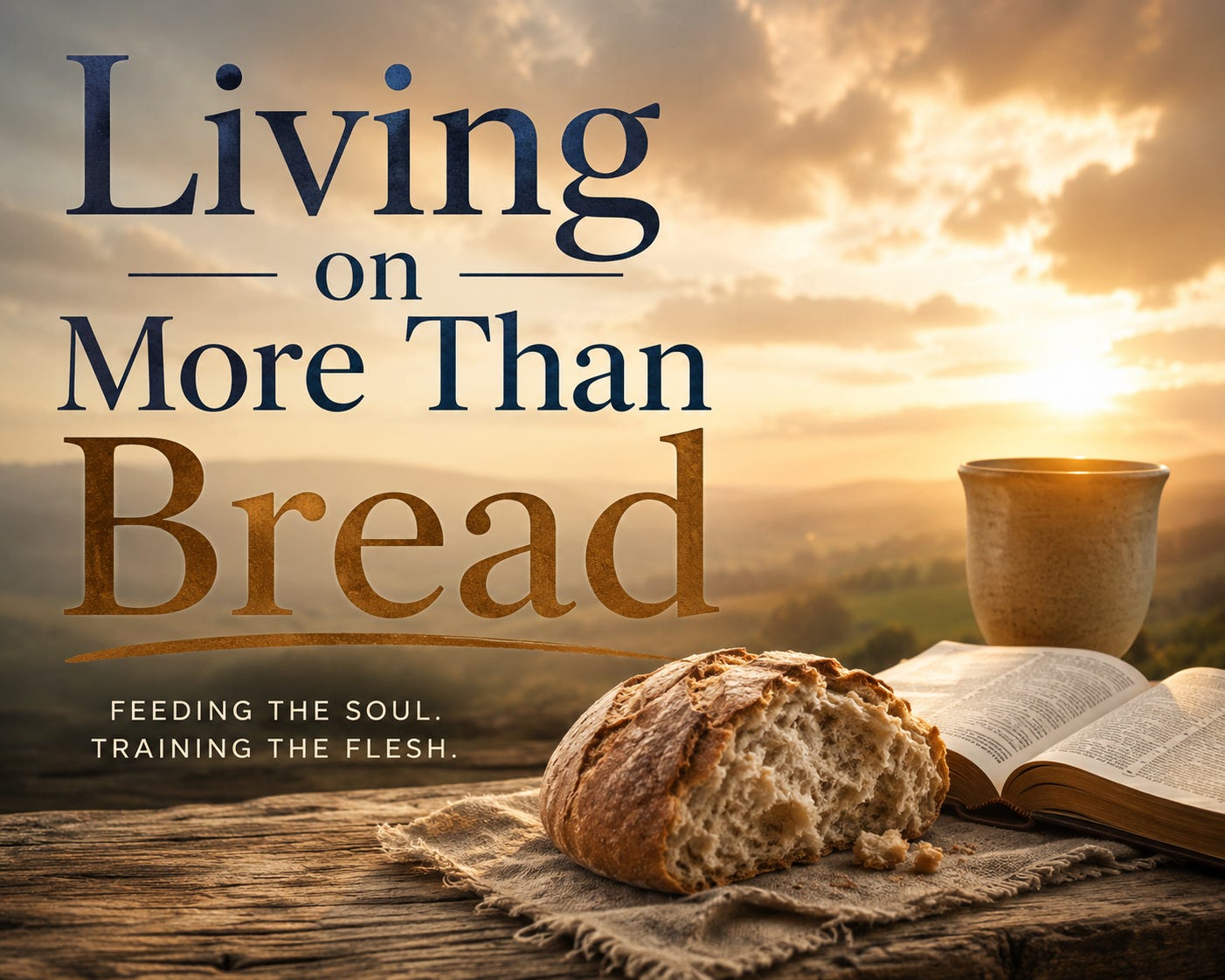
When most people think about fasting, they think about going without food. That is certainly part of it, but Jesus’ teaching suggests that something deeper is happening. In the Gospels, there are two moments where Jesus connects food and fasting to a greater spiritual reality. Those moments help us understand that fasting is not primarily about what we stop eating. It is about what we learn to feed on instead.
The first moment comes during Jesus’ temptation in the wilderness. After fasting for forty days, Satan tempts Him to turn stones into bread. Jesus responds by quoting Scripture, saying that man does not live by bread alone, but by every word that comes from the mouth of God. Physical food sustains physical life, but Jesus points to another source of life that is just as real. The soul is fed by the truth that comes from God.
The second moment takes place in Sychar after Jesus speaks with the woman at the well. The disciples return from town with food and urge Him to eat. Jesus tells them that He has food they know nothing about and explains that His food is to do the will of the Father who sent Him. Once again, Jesus connects nourishment to something greater than physical consumption. He describes obedience itself as a source of spiritual sustenance.
Taken together, these two passages reveal an important truth. The soul is fed by the Word of God and by obedience to that Word. Truth received and truth applied become nourishment for the inner life. Jesus did not merely know the Father’s will; He delighted in doing it. His life demonstrates that there is a spiritual reality every bit as real as the physical one.
Most of us recognize the signs of physical hunger almost immediately. Our stomach growls. We develop a headache. We become weak or irritable. Some people, like my wife, become “hangry,” which is our family’s way of saying that hunger has started affecting attitude and emotions. We know the signals because we have spent our entire lives learning how our bodies communicate their desires.
Fasting creates an opportunity to notice those desires and respond differently. When hunger appears, we become aware of how quickly our bodies demand satisfaction. We begin to see how many of our daily decisions are driven by impulses, cravings, and comforts. The physical appetite becomes a teacher that exposes deeper patterns within us.
That is why I do not think fasting is automatically spiritual in and of itself. People who have no interest in Christ fast for health reasons every day. Intermittent fasting, juice fasting, and other forms of fasting have become common throughout our culture. Many of those practices can produce real physical benefits, but physical benefits alone do not make something spiritual.
Likewise, fasting is not a tool for forcing God’s hand. Sometimes Christians can begin to think of fasting as prayer with extra horsepower. The assumption is that if prayer is not working, then prayer plus fasting will finally get God’s attention. As though God looks down and says, “Now I know they are serious.” That understanding misunderstands both fasting and the character of God.
God is not reluctant to hear His children. He is not waiting for us to become hungry enough before He listens. Fasting does not back God into a corner. It does not manipulate Him, pressure Him, or increase His willingness to act. The purpose of fasting is not to change God’s posture toward us. It is to change our posture toward Him.
Fasting is training. It is a practice that teaches the body to come into alignment with the new life we have received in Christ. Every time we say no to one desire and yes to a greater desire, we are strengthening spiritual muscles that are often weak from disuse. We are learning that not every appetite deserves immediate obedience.
Before Christ, we were slaves to sin. We lived according to the desires that ruled us. We followed whatever cravings happened to be strongest at the moment. In Christ, however, we have been set free. We now possess the ability to choose obedience even when our desires are pulling us in another direction.
That freedom does not mean the struggle disappears. Paul describes that struggle clearly in Romans 7. He explains that when he wants to do good, he often finds another force working against him. The good he desires is not always the good he does. Every Christian knows this tension through personal experience.
The grace of God in Christ gives us hope in that struggle, but grace does not eliminate the need for training. The New Testament repeatedly calls believers to exercise themselves toward godliness. Paul compares the Christian life to athletic training. He speaks of disciplining his body and bringing it under control. Jesus tells His disciples in Gethsemane that the spirit is willing but the flesh is weak. These images all point in the same direction.
Fasting gives practical expression to that reality. It creates a small arena where obedience can be practiced intentionally. Hunger says one thing. The spirit says another. In that moment, we learn to listen carefully and choose deliberately. Over time, those repeated choices begin shaping our responses in other areas of life as well.
The goal is not becoming impressive at fasting. The goal is becoming responsive to the Spirit of God. A person can become highly skilled at going without food and still remain immature in character. The value of fasting is found in what it teaches us about obedience, self-control, and dependence upon God.
A group of disciples that I am part of has recently begun practicing fasting together. We are not approaching it as experts. We are learning, making mistakes, asking questions, and developing understanding through practice. Like any discipline, it becomes clearer through experience than through discussion alone.
We are not fasting because we believe God needs convincing. We are fasting because our flesh needs training. We are learning to tell our bodies that they are not in charge. We are teaching our appetites to listen rather than lead.
As we learn to feed on God’s Word and obey what He says, we discover the same reality Jesus described. There is a food the world does not understand. There is nourishment found in truth and obedience that cannot be purchased, prepared, or consumed at a table. When pressure comes, the goal is that obedience will not feel foreign or forced. It will feel familiar because we have practiced it, trained for it, and learned to live by every word that comes from the mouth of God.
We desire for our desires to align with the Word of God and obedience to Him. Our spirits are willing, and by God’s grace through a little practice we trust our bodies will become more our soul’s helpful partner rather than a constant obstacle.