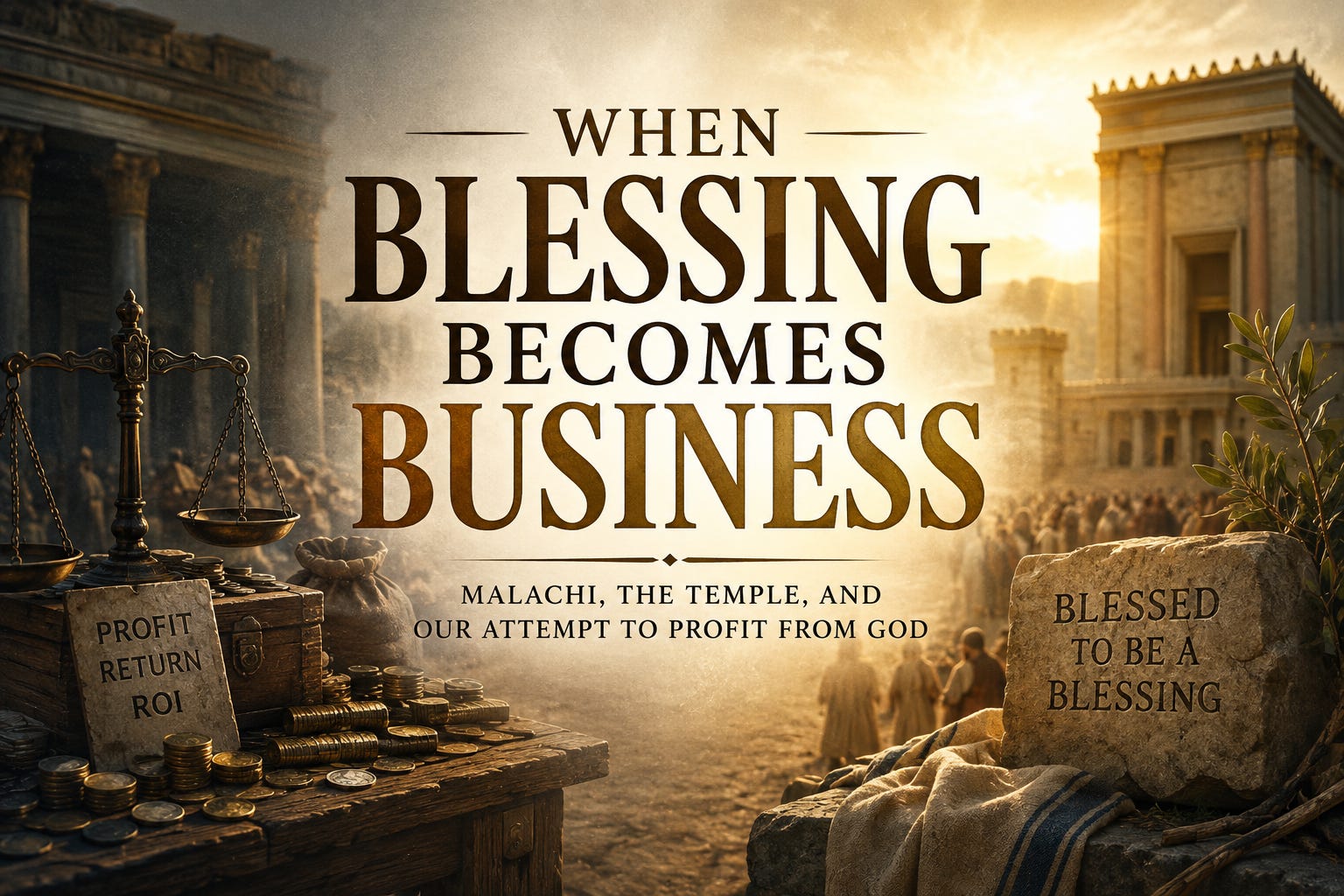
When Blessing Becomes Business
Malachi, the Temple, and Our Attempt to Profit From God

Malachi closes the Old Testament looking forward. In chapters 3 and 4, the prophet speaks of a coming messenger who will prepare the way of the Lord. The Lord Himself will then come to His temple, bringing a refining and purifying work among His people. Malachi ends with the promise that Elijah will come before the great and terrible day of the Lord.
Jesus identifies John the Baptist with that promised Elijah figure. John comes in the spirit and power of Elijah, calling Israel to repentance and preparing the way for the Messiah. This places the beginning of Jesus’ ministry directly inside the prophetic expectation created by Malachi. The story of Jesus at the Jordan, in the wilderness, and eventually in the temple should be read against that background.
Jesus enters the Jordan and is identified by the Spirit at His baptism through the ministry of John. The scene carries echoes of Elijah and Elisha, where the mantle passes and the Spirit rests upon the one who will continue the work. John, the Elijah-like herald, prepares the way, and Jesus emerges from the Jordan as the Spirit-anointed Messiah. After fasting and overcoming temptation in the wilderness, Jesus returns in the power of the Holy Spirit.
Then Jesus comes to His temple… And starts turning over tables.
When the Lord Comes to His Temple
Malachi had asked, “Who can endure the day of his coming? And who will be able to stand when he appears?” The prophet described Him as a refiner’s fire and a launderer’s bleach, purifying the people of God so their worship could once again become righteous. Centuries later, Jesus walks into the temple courts and confronts an economy that has grown up around worship.
Zechariah adds another piece to the prophetic picture. His final vision looks toward the day when everything will become holy to the Lord, even ordinary cooking pots. He concludes with the striking declaration that there will no longer be a trader in the house of the Lord, a word that is also referred to as a Canaanite. In other words, the house of the God will no longer be a place to write cheap contracts with a god for success guarantees in my kingdom. Which is what every nation around Israel for their entire history up to this point used the “gods” for.
Enter Jesus. Who is not looking for success from the Father, he is living in faithfulness to him.
The Elijah-like messenger has prepared His way. The Spirit has come upon Him. The wilderness has tested Him. Now the Lord enters His temple and drives out the traders.
The act reaches beyond an objection to dishonest business practices. Jesus confronts a way of relating to God that has become entangled with exchange, profit, and religious advantage. The temple has become a place where people can transact around the things of God. The prophetic hope of Malachi and Zechariah suddenly stands in the middle of Jerusalem with a whip in His hand.
That brings us directly back to Malachi 3.
How Have We Robbed You?
God makes a startling accusation against Israel: “You are robbing me.”
The people respond, “How do we rob you?”
God answers by pointing to the tithe and contributions they have withheld. This is usually where modern Christian conversations begin arguing about whether Christians should tithe. Entire theological systems emerge around ten percent, gross versus net income, Old Covenant law, New Covenant generosity, church budgets, prosperity, and financial blessing.
Meanwhile, the larger prophetic picture dissipates in the flood of mammonville.
Pull your eyes above the sea of Western individualism for just a moment and Malachi begins to look different. God is addressing a people whose economic decisions reveal what kind of community they have become. Their withholding reveals worship, priests, Levites, families, strangers, widows, the vulnerable, and ultimately the character of Israel itself.
A society that consistently withholds its best from accountability to God and His ways will eventually withhold most from its neighbor. Jesus’ teaching making sense? Love God with everything, and love your neighbor as yourself.
Israel’s problem reaches far beyond failing to meet a religious percentage. Their money exposes what they believe about God and one another.
The Floodgates Are Bigger Than Your Bank Account
God tells Israel to bring the full tenth into the storehouse and then gives one of Scripture’s most famous promises: He will open the floodgates of heaven and pour out blessing without measure. Read through individualistic eyes, this can easily become a spiritual investment strategy. Give God the required amount, activate the promise, and expect a return.
God becomes the safest investment available.
Put ten percent in.
Wait.
Collect the divine ROI.
The promise then becomes a contractual obligation that God must fulfill while the giver remains free to pursue whatever kind of life he wants with the remaining ninety percent. If the expected return fails to arrive, disappointment follows. Eventually disappointment becomes accusation.
And that is exactly where Malachi goes next…
The people complain that serving God has been useless. They have observed the world around them and concluded that arrogant and wicked people prosper. Evildoers seem to succeed. Those who challenge God appear to escape judgment.
Their complaint exposes the deeper problem.
They expected a return.
When God Becomes a Contract
Israel looks at its circumstances and essentially says, “We trusted You, God, but when we verified Your promise, the numbers did not work.”
The religious appear poor.
The wicked appear rich.
Therefore, God failed to perform.
That is contractual thinking.
Contracts create an environment where two or more parties agree to cooperate toward something worthwhile while acknowledging that neither party can be completely trusted to keep their word. Responsibilities get written down. Expectations become measurable. Accountability mechanisms are established, and coercion remains available if someone refuses to perform.
A contract says, “I trust you enough to work with you, but I need protection if you fail me.”
Israel begins treating covenant that way. They obey, sacrifice, give, and practice religion with an expected return attached. Then they examine the outcomes and conclude that God has violated the agreement.
“We served You. They didn’t.”
“They prospered. We didn’t.”
“So what did we get for serving You?”
God refuses to play their game.
Instead, Malachi turns our attention toward another group of people.
The People Who Feared the Lord
In the middle of Israel’s accusation, Malachi describes a faithful remnant. Those who feared the Lord spoke with one another, and the Lord listened. They held His name in high regard, and God claimed them as His own.
Something entirely different is happening among these people.
They are living covenantally.
Covenant begins with character rather than leverage. God blesses because He is good. His people recognize the character and source of that blessing, become like Him, and begin blessing others. Their shared life increasingly reflects the God with whom they live.
The outcome is a flourishing community.
This is the vision Malachi eventually describes: “Then all the nations will consider you fortunate, for you will be a delightful land.”
Notice the scale of the promise.
A delightful land.
God’s blessing creates a kind of people whose life together becomes desirable. Their worship, generosity, justice, relationships, economic practices, and treatment of one another demonstrate what happens when human beings live under the goodness of God. The blessing received from God moves through the people of God and becomes blessing to others.
God blesses people.
Blessed people learn His character.
People shaped by His character bless people.
The community flourishes.
The nations notice.
That is covenant.
Jesus Builds the Delightful Land
Back to Jesus. Whip now laying beside the scattered tables, “Repent, because the kingdom of heaven has come near.”
He clears the traders from the temple and begins forming a people who live according to an entirely different economy. He teaches them to give, forgive, serve, pray, reconcile, show mercy, seek righteousness, love enemies, care for the needy, and trust their Father for provision. He calls these people blessed and then tells them what those blessed people are supposed to become.
They become salt.
They become light.
They become a city on a hill.
Malachi calls it a delightful land. Jesus calls it a city that cannot be hidden.
The pattern remains remarkably similar. God pours His goodness into a people who receive it as gift rather than payment. Those people become increasingly like the God they trust. His generosity becomes their generosity. His mercy becomes their mercy. His faithfulness shapes their faithfulness, and His concern for others begins governing their relationships.
The blessing keeps moving.
That is why Jesus can tell people who have been blessed that they should freely give. They do not need to hoard the blessing to prove that they received it. The abundance of the Father becomes visible through the generosity of His children. Remember the father when the faithful oldest son complains about the party for the returned unfaithful son? “All I have has always been yours. So let’s celebrate because your brother was lost and now he is found.” We aren’t going to run out boy, our family has plenty to go around.
The floodgates of heaven have opened, and the evidence is a people through whom blessing keeps flowing.
What Return Are You Expecting?
Those determined to measure themselves against the wicked will hear Malachi through the language of transaction.
Investment.
Return.
Profit.
Personal prosperity.
They want to know what serving God will produce for them during this life. They compare houses, businesses, health, influence, opportunities, and bank accounts and wonder whether righteousness has produced an acceptable return.
Those who understand covenant hear something different.
Blessed to be a blessing.
They see the possibility of a delightful land where people who love God actually learn to love one another. They see a kingdom where generosity can replace scarcity, trust can overcome fear, and people can seek another person’s good without calculating what they will receive in return.
That requires a fundamentally different relationship with God.
As long as God remains a contract, He remains untrusted. We will continually examine the results to determine whether He has kept His side of the bargain. Every disappointment becomes evidence against Him, and every act of obedience carries an unstated invoice.
Covenant changes the question.
Instead of asking, “What will I get if I give this to God?” we begin asking, “What does God treasure?”
Then we treasure it too.
You Cannot Serve God and Mammon
This is where Malachi’s prophetic vision eventually collides with the words of Jesus.
“You cannot serve both God and money.”
Jesus does not leave room for Mammon to become a tool for measuring whether God has been faithful. Eventually the return we expect determines the joy we receive. If our expectation is wealth, comfort, security, status, or earthly prosperity, then obedience that fails to produce those things will eventually feel disappointing.
We may even accuse God of failing us.
Malachi has heard that accusation before.
“What have we gained by keeping his requirements?”
That question still exposes the heart.
As long as we search for a way to make greed righteous, we will struggle to understand the kingdom of God. We can baptize accumulation with religious language, turn generosity into an investment strategy, and quote promises over our ambitions. Eventually Mammon reveals itself through the return we demand.
Jesus offers another treasure.
He tells us to stop storing everything where moth and rust destroy and thieves break in and steal. He invites us into the life of the Father, where we learn to treasure what God treasures. Our resources, bodies, relationships, businesses, homes, tables, and communities become places where His generosity can take visible form.
The result is more than increased possessions.
It is a different quality of life. Eternal life that is everlasting.
New creation produces people capable of living covenantally because the character of God increasingly becomes their own. Blessed people become blessings. Generous people create generous communities. Faithful people create trustworthy relationships. People who have received mercy learn to give mercy freely.
Eventually the nations look at such a people and see something remarkable.
A delightful land.
A city on a hill.
The kingdom of heaven at hand.
The floodgates of heaven wide open.
Followers of Jesus have these keys to the kingdom, but so did the Pharisees of Jesus day. Like the older son, they didn’t want to let anyone in and wouldn’t go in themselves, because to do so would mean less for them. Give as little as is necessary to get what I want, no matter how religious it is presented, is never the character of the Father who said,
“Bring the full tenth into the storehouse so that there may be food in my house. Test me in this way,” says the Lord of Armies. “See if I will not open the floodgates of heaven and pour out a blessing for you without measure. I will rebuke the devourer , for you, so that it will not ruin the produce of your land and your vine in your field will not fail to produce fruit,” says the Lord of Armies. “Then all the nations will consider you fortunate, for you will be a delightful land,” says the Lord of Armies.”
Malachi 3:10-12 CSB
May we be about the business of blessing. May our church communities be considered a fortunate and delightful land by the nations. Lord, make us so.